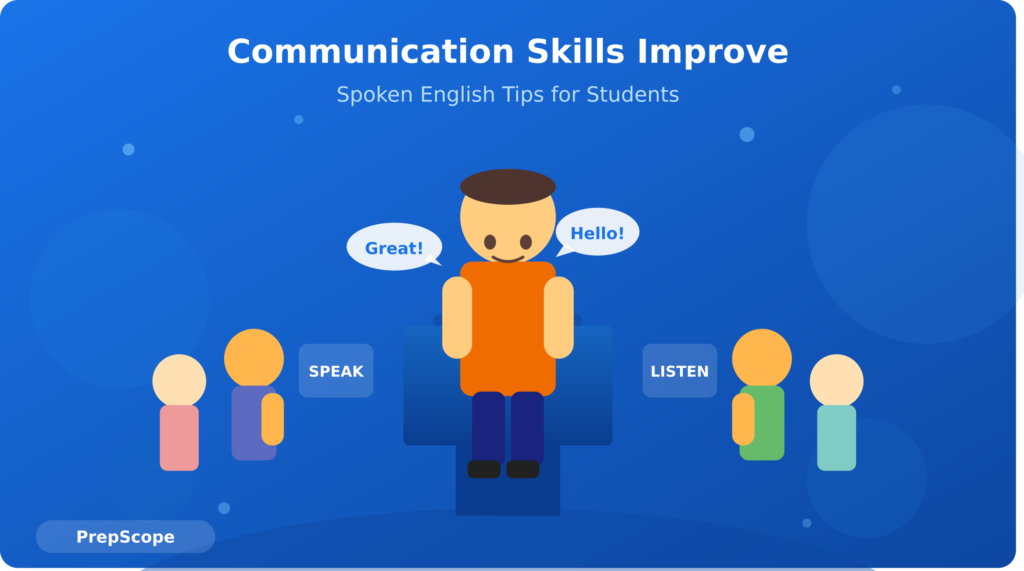
Let’s be honest — communication skills improve your career faster than any
degree or certificate ever will. In a world where first impressions are made
in seconds, the way you speak, present yourself, and express your ideas is
everything. Whether you’re a student gearing up for placements, a fresher
facing your first interview, or just someone who wants to finally speak
English with real confidence — you’re in the right place.
According to the National Association of Colleges and Employers (NACE), communication skills consistently rank as the number one quality employers look for in candidates — above technical knowledge, GPA, and even work experience. Yet most students never receive structured guidance on how to actually develop this skill.
That is exactly what this guide is for. At PrepScope, we have helped thousands of students transform their communication — and in this post, we are sharing everything you need to know: from spoken English tips for students to confidence-building techniques that genuinely work.
What Are Communication Skills and Why Do They Matter?
Before diving into the how, let us understand the what. Communication skills are not just about speaking fluent English. They encompass a much broader set of abilities:
- Verbal communication — what you say and how you say it
- Non-verbal communication — your body language, eye contact, facial expressions, and posture
- Active listening — the ability to hear, understand, and respond thoughtfully
- Written communication — emails, reports, messages, and professional writing
- Presentation skills — organizing and delivering ideas clearly in front of an audience
When all of these work together, you become someone people trust, follow, and want to work with. That kind of presence opens doors — in interviews, at the workplace, and in everyday life.
How to Improve Communication Skills: 10 Proven Strategies
1. Practice Speaking Every Single Day
This is the single most important spoken English tip for students, and yet it is the one most people skip. The truth is simple: you cannot improve communication skills by only reading about them. You have to speak.
Start small and build consistency:
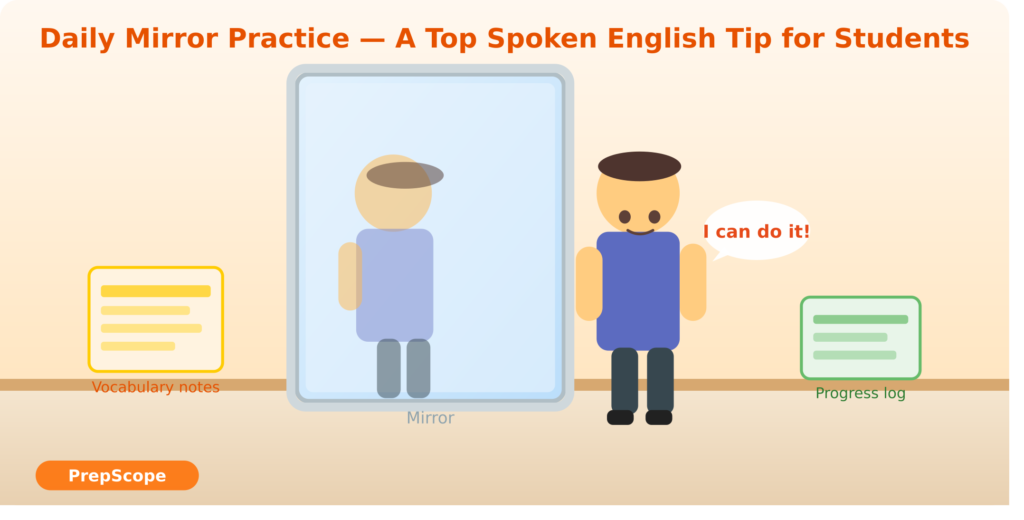
- Spend 5 minutes every morning doing mirror practice — talk to yourself as if you are giving a presentation
- Record yourself speaking on a topic for 2 minutes and play it back
- Have at least one full conversation in English every day, even if it is with a friend or family member
- Narrate your daily activities in English in your head — this builds real-time thinking in the language
The goal is not perfection from day one. Fluency comes from volume, not from caution. The more you speak, the faster you improve.
2. Consume English Content Actively
One of the most underrated spoken English tips for students is to immerse yourself in the language through content you already enjoy. The brain absorbs language patterns naturally when exposed to them repeatedly.
Here is how to make this a habit:
- Read one English article or news piece every day — The Hindu, BBC, or The Guardian are great starting points
- Listen to English podcasts designed for learners, such as BBC 6 Minute English or ESL Pod
- Watch English movies and series — start with subtitles, then try without them as your comprehension grows
- Shadow native speakers: pause, repeat, and mimic their pronunciation and rhythm
Active consumption — where you pay attention to new words, sentence structure, and tone — is far more effective than passive watching or reading.
3. Build Your Vocabulary Strategically
A strong vocabulary does not mean using complex or rare words. It means having the right words available when you need them — so your thoughts come out clearly and confidently.
Here is a practical approach:
- Learn 5 new words every day — but more importantly, use each one in a sentence immediately
- Keep a dedicated vocabulary notebook, organized by topic (e.g., business, emotions, opinions)
- Use spaced repetition apps like Anki or Quizlet to retain words long-term
- Learn synonyms and antonyms to give your speech variety and range
- Pay attention to collocations — word pairs that naturally go together, like “make a decision” or “take action”
Within three months of consistent practice, you will notice your speech becoming noticeably richer and more precise.
4. Master Body Language and Tone
Research from communication experts suggests that a large portion of what we communicate is non-verbal. Your words may be technically correct, but if your body language is closed or your tone is flat, the message loses its impact.
Focus on these fundamentals:
- Eye contact — hold it naturally; it signals confidence and builds trust with your listener
- Posture — stand or sit straight; avoid slouching, which projects low energy
- Hand gestures — use them to emphasize points, but avoid nervous fidgeting
- Tone variation — raise and lower your volume and pitch for emphasis; a monotone voice loses attention fast
- Pace — speak at a measured speed; rushing through sentences makes you harder to follow
Practice these in front of a mirror or record a short video of yourself speaking. You will be surprised how much small adjustments can change the overall impression.
5. Become an Active Listener
Great communicators are not just great speakers — they are exceptional listeners. Active listening is a skill that most students overlook, but it is what separates average communicators from truly effective ones.
How to practice active listening:
- Put your phone away and give the speaker your complete attention
- Avoid mentally preparing your reply while the other person is still speaking
- Summarize what you heard — “So what you are saying is…” — this confirms understanding and shows engagement
- Ask thoughtful follow-up questions — it shows that you processed what was said
- Pay attention to emotion and tone, not just words — this helps you respond appropriately
In interviews and group discussions, strong listening skills make you stand out immediately.
6. Join Group Discussions and Debate Clubs
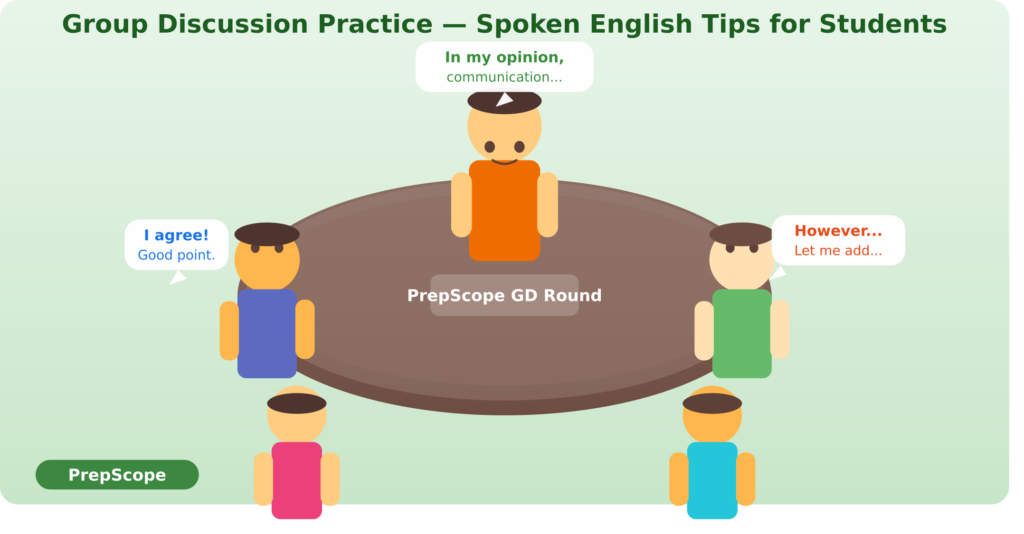
For students especially, group discussions (GDs) are both a learning ground and a practical testing arena. Most campus placements and postgraduate admissions include a GD round — so learning to communicate in a group setting is essential.
Here is how to get started:
- Join your college’s debate club, public speaking society, or student council
- Organize informal mock GDs with your friends once a week
- Watch recorded GD sessions on YouTube and note the strategies top performers use
- Use PrepScope’s structured GD practice modules to get real feedback from experts
The more often you put yourself in these situations, the more natural it feels.
7. Work on Pronunciation and Clarity
You do not need a foreign accent to be a great English speaker. What you do need is clarity — the ability to be understood easily by anyone listening to you.
Practical tips to improve pronunciation:
- Use online tools like Cambridge Dictionary or Forvo to hear the correct pronunciation of unfamiliar words
- Practice tongue twisters daily — they significantly improve articulation and mouth muscle coordination
- Pay attention to word stress — for example, the stress in photograph and photography falls on different syllables, which changes how they sound
- Slow down when speaking — speed is the enemy of clarity, especially when you are still building fluency
- Record yourself and compare your pronunciation to a native speaker or language reference
8. Develop Structured Thinking
Clear communication is a reflection of clear thinking. If your thoughts are scattered, your speech will be too. Learning to organize your ideas before and while speaking is one of the most powerful communication skills you can develop.
Use the PREP Method for any situation — interviews, GDs, or presentations:
- P — Point: State your main idea upfront
- R — Reason: Explain why you believe this
- E — Example: Support it with a real or relatable example
- P — Point: Wrap up by restating your key message
This simple framework gives structure to anything you say and makes you sound confident and well-prepared — even when speaking on the spot.
9. Build Confidence by Facing the Fear
One of the most common barriers to improving communication skills is fear — fear of making mistakes, fear of being judged, fear of speaking in public. This fear is completely normal, and practically every great communicator has faced it.
The only way through it is consistent exposure:
- Start speaking in front of small, safe groups — 2 or 3 trusted friends — and gradually increase the audience size
- Volunteer to speak up in class, even for small contributions
- Join online communities like Toastmasters International, where the entire purpose is to help people grow as speakers in a supportive environment
- Use positive self-talk: “I am prepared. I have something valuable to say.”
- After every speaking experience, reflect briefly — what went well, and what can be improved next time
Confidence is not something you are born with. It is something you build, one conversation at a time.
10. Seek Feedback and Track Your Progress
Improvement without feedback is slow and uncertain. The fastest way to grow is to regularly get honest, constructive input on your communication.
How to build a feedback loop:
- Ask a trusted mentor, teacher, or friend to give you honest observations after a practice session
- Record your presentations and speeches and analyze them yourself — look for filler words, pacing issues, and unclear points
- Use PrepScope’s AI-powered mock interview and GD sessions, which provide structured, actionable feedback
- Track your progress over time — keep a log of what you are working on and how it is evolving
Even small, incremental improvements compound into significant transformation over weeks and months.
Spoken English Tips for Students: Quick Reference Table
One of the most practical spoken English tips for students is to structure your practice — not just practice randomly. Use this table as your daily and weekly roadmap:
| Skill Area | Daily Practice (10–15 min) | Weekly Goal |
|---|---|---|
| Speaking | Mirror practice or self-recording | 1 full topic discussion (5 min) |
| Listening | English podcast or video | 3 episodes with note-taking |
| Vocabulary | 5 new words with sentences | 35 new words in context |
| Reading | 1 English article | 5–7 articles across topics |
| Writing | Short journal entry | 3–4 entries |
| Confidence | Speak up once in a group | 1 live GD or debate practice |
5 Common Mistakes Students Make (And How to Avoid Them)
Even students who follow spoken English tips for students regularly can fall into these traps. Knowing them in advance puts you ahead of the curve.
Mistake 1: Focusing too much on grammar This is one of the biggest mistakes — and every spoken English guide for students mentions it for good reason. Grammar matters, but obsessing over it while speaking causes hesitation and kills fluency. Focus on being understood first — accuracy will follow naturally with practice.
Mistake 2: Studying but not speaking Watching videos and reading articles helps, but no spoken English tip for students works unless you actually open your mouth and speak. Passive learning alone will never improve your fluency. You have to practise out loud, every single day.
Mistake 3: Being afraid of making mistakes Mistakes are not failure — they are feedback. Every great communicator has stumbled through sentences, mispronounced words, and lost their train of thought. What sets them apart is that they kept going. The best spoken English tip for students who feel shy? Speak anyway.
Mistake 4: Practising only in bursts Two hours of practice on one day, followed by a week of silence, does not work. Fifteen minutes of consistent daily practice will always outperform occasional marathon sessions. Consistency is the core of every effective spoken English strategy for students.
Mistake 5: Waiting until you feel “ready” There is no perfect moment to start. The best time to apply these spoken English tips for students is right now, with whatever level you are at today.
How PrepScope Helps You Put Spoken English Tips for Students Into Practice
Reading spoken English tips for students is one thing — actually implementing them with guidance and feedback is another. PrepScope is built specifically for students who want to be genuinely interview-ready and career-confident. Here is what the platform offers:
- Mock Interview Sessions — practise in a real interview-like environment with detailed feedback on your spoken communication
- Group Discussion Modules — structured GD practice with performance analysis and expert tips
- Spoken English Exercises — targeted activities for fluency, pronunciation, and confidence, designed specifically as spoken English practice for students
- Expert-Curated Resources — tips, frameworks, and strategies from industry professionals who know what interviewers are really looking for
Thousands of students have used PrepScope to go from hesitant to confident, from rejected to placed. You can be next.
Frequently Asked Questions (FAQs)
Q1. How long does it take to see spoken English improve for students? With consistent daily practice of 20–30 minutes, most students notice meaningful improvement within 30 to 60 days. Significant fluency and confidence gains typically come within 3 to 6 months of following structured spoken English tips for students.
Q2. Can I improve my spoken English without a coach or institute? Absolutely. Self-study, online resources, and platforms like PrepScope give you everything you need. The spoken English tips for students in this guide are entirely self-applicable. What matters most is consistency and intentional daily practice.
Q3. How do I overcome nervousness when speaking in English? Preparation is the biggest confidence builder. The more prepared you are, the less nervous you feel. Start with low-stakes situations — speaking with a friend or recording yourself — and progressively move to larger or more formal settings. This is one of the most repeated spoken English tips for students who struggle with stage fear.
Q4. What are the best apps for spoken English practice for students? Some highly effective options include ELSA Speak for pronunciation, BBC Learning English for structured lessons, Anki for vocabulary building, and Duolingo for daily practice habits. Combined with the spoken English tips for students in this post, these apps can accelerate your progress significantly.
Q5. How can I demonstrate strong communication skills in a job interview? Speak clearly and at a measured pace. Use the PREP framework to structure your answers. Listen carefully before responding. Maintain confident body language. Ask thoughtful follow-up questions — it signals genuine interest and strong listening ability.
Q6. Is it necessary to speak with a neutral or foreign accent? No. Clarity matters far more than accent. Employers and interviewers are looking for someone who can be understood, express ideas well, and communicate with confidence — not someone who sounds like they are from a particular country.
Conclusion
All the spoken English tips for students in the world mean nothing without consistent action. Improving your communication skills is one of the most transformative things you can do for your academic and professional future — and it absolutely happens, with the right effort and the right guidance.
Here is a quick recap to take with you:
- Speak every day, even for just 10 to 15 minutes
- Actively consume English content — podcasts, articles, videos
- Build vocabulary in context, not in isolation
- Work on body language and tone alongside your words
- Practice active listening — it is half of every conversation
- Come back to these spoken English tips for students whenever you need a reset
- Seek feedback regularly and track your growth
Your communication journey starts today. And with PrepScope by your side, you do not have to figure it out alone.
Ready to put these spoken English tips for students into action? Join PrepScope and start your free practice session today. →prepscope.com